Copyright 2001, Michael McCann with The Business
Cafe. All Rights Reserved.
http://www.globalbusinesscafe.com/
All comments should be directed to Michael McCann at >
mccann@nc.rr.com


The origin of Santa Claus depends on which country's story you choose to adopt. Santa Claus comes from the Dutch words "Sinter Klaas", which is what they call their favorite saint, St. Nicholas. He is said to have died on December 6, A.D. 342. December 6th is celebrated as his feast day, and in many countries this is the day he arrives with his presents and punishments.
Nicholas lived in what is now called Turkey. He was born about A.D. 280 in the town of Patras. His parents were wealthy and he was well educated. Nicholas seems to have had a remarkable childhood. While still a young boy he was made Bishop of Myra, and because of this he has been known ever since as the Boy Bishop. He was renowned for his extreme kindness and generosity – often going out at night and taking presents to the needy. Santa's rise to fame can be traced to two legends – the three daughters and the children at the Inn.
The first story shows his generosity. There were three unmarried girls living in Patras who came from a respectable family, but they could not get married because their father had lost all his money and had no dowries for the girls. The only thing the father thought he could do was to sell them when they reached the age to marry. Hearing of the imminent fate, Nicholas secretly delivered a bag of gold to the eldest daughter, who was at the right age for marriage but had despaired of ever finding a suitor. Her family was thrilled at her good fortune and she went on to become happily married. When the next daughter came of age, Nicholas also delivered gold to her.
According to the story handed down, Nicholas threw the bag through the window and it landed in the daughter's stocking, which she had hung by the fire to dry. Another version claims that Nicholas dropped the bag of gold down the chimney.
By the time the youngest daughter was old enough for marriage, the father was determined to discover his daughters' benefactor. He, quite naturally, thought that she might be given a bag of gold too, so he decided to keep watch all night. Nicholas, true to form, arrived and was seized, and his identity and generosity were made known to all. As similar stories of the bishop's generosity spread, anyone who received an unexpected gift thanked St. Nicholas.
 Another one of the many stories told about St. Nicholas explains
why he was made a patron saint of children. On a journey to Nicaea,
he stopped on the way for the night at an inn. During the night
he dreamt that a terrible crime had been committed in the building. His dream was quite horrifying. In it three young
sons of a wealthy Asian, on their way to study in Athens, had been
murdered and robbed by the innkeeper. The next morning he confronted
the innkeeper and forced him to confess. Apparently the innkeeper
had previously murdered other guests and salted them down for pork
or had dismembered their bodies and pickled them in casks of brine.
The three boys were still in their casks, and Nicholas made the
sign of the cross over them and they were restored to life.
Another one of the many stories told about St. Nicholas explains
why he was made a patron saint of children. On a journey to Nicaea,
he stopped on the way for the night at an inn. During the night
he dreamt that a terrible crime had been committed in the building. His dream was quite horrifying. In it three young
sons of a wealthy Asian, on their way to study in Athens, had been
murdered and robbed by the innkeeper. The next morning he confronted
the innkeeper and forced him to confess. Apparently the innkeeper
had previously murdered other guests and salted them down for pork
or had dismembered their bodies and pickled them in casks of brine.
The three boys were still in their casks, and Nicholas made the
sign of the cross over them and they were restored to life.
In newly Christianized areas where the pagan Celtic and Germanic cults remained strong, legends of the god Wodan were blended with those of various Christian saints; Saint Nicholas was one of these. There were Christian areas where Saint Nicholas ruled alone; in other locations, he was assisted by the pagan Dark Helper (the slave he had inherited from the Germanic god Wodan). In other remote areas, where the Church held little power, ancient pockets of the Olde Religion controlled traditions. Here the Dark Helper ruled alone, sometimes in a most confusing manner, using the cover name of Saint Nicholas or "Klaus," without in any way changing his threatening, Herne/Pan, fur-clad appearance. (This was the figure later used by the artist Nast as the model for the early American Santa Claus.)
The Catholic Saint Nicholas also had a confusing past. He was a compilation of two separate saints (one from Myra in Asia Minor, the other from Pinora), both of whom were – as the Church now admits – nothing more than Christianized water deities (possibly related to the Greco-Roman god Poseidon/Neptune.)
After the Vikings raided the Mediterranean, they brought the Christian Saint Nicholas cult from Italy to northern Europe, and there proceeded to build Saint Nicholas churches for the protection of their sailors. When, for instance, William the Conqueror's fleet was hit by a storm during his invasion of England, he is known to have called out for protection to Saint Nicholas. Although in those days, church services only mentioned Saint Nicholas as the protector of seafarers, they initially condoned a blending of the Mediterranean Nicholas myths with some that had been attached to the pagan Germanic god Wodan and to those of the even earlier Herne/Pan traditions.
By absorbing such pagan feasts and traditions, the Christian Church could subtly bring in its own theology: in this case, establishing the good Saint Nicholas, bringer of love and gifts, while grudgingly allowing the presence of the Olde Religion's Herne/Pan, but only as a slave to Saint Nicholas. Thus, in parts of Europe, the Church turned Herne into Saint Nicholas' captive, chained Dark Helper; none other than Satan, the Dark One, symbolic of all evil. His only remaining tasks now were to carry the bag, scare maidens and children into devout behavior, and drag sinners and pagans off to the Christian hell. Yet, in spite of this character assassination, the poor masses continued to see in this enslaved Dark Helper a reflection of their own enslavement. He remained their Herne, thumbing his nose at the Christian Church; a mischievous, nostalgic reminder of the days of their own free and lusty pagan past.
In Holland and several other European countries, the Saint Nicholas figure is still highly esteemed. He appears as a tall dignified bearded white-haired old man dressed as a Catholic bishop complete with cloak, mytre, and pastoral staff, a seemingly genuine Catholic saint, but with a bizarre quite unsaintly habit of riding through the skies on a white horse followed by his Dark Helper. It seems that our Catholic saint inherited some of these customs from the pagan Germanic god Wodan, who had also been a bearded, white-haired old man, also dressed in a hat and cloak, carried a staff (or spear), rode a holy white horse and dragged along the same dark slave/helper on a chain.
The Dutch Sinterklaas brings gifts to good children, while bad children are harassed by Zwarte Piet, the Dark Helper, who – brandishing his peculiar broom-like rod – threatens to put sassy young women and naughty children in the sack in which he has carried the gifts, the idea being that he will take them away to some terrible place in Spain (where Saint Nicholas, for no known historical reason, was supposed to have come from). This, of course, never happens since the good Christian Sinterklaas always intervenes on behalf of the naughty child – provided the child promises to better his or her ways. The bad (pagan) Dark Helper is then admonished by Sinterklaas and ordered to stop threatening the children.
Next, Sinterklaas distributes gifts to all "who have been good" (or until the twentieth century, to all "who knew their prayers"). In exchange, the children are supposed to leave food offerings for the saint's horse (usually hay and carrots), placed in either a shoe or stocking. In some areas, a glass of gin is also left as an offering for the good saint himself. When, by daybreak, the offerings have disappeared and been replaced by gifts, it proves that Sinterklaas has indeed paid a visit during the night.
We can clearly recognize in all this the lesson taught the pagans by the Christian Church, here represented by Saint Nicholas: You may enjoy your old fall/winter feasts, as long as you have learned your prayers and become good Christians. You will then be rewarded, but if you have not done so, you will be dragged away to hell by your own fearful, pagan past and its representative, the dark Herne/Pan – who is none other than Satan himself – unless you repent, here and now!
Nicholas' natural affinity with children led him to be adopted as their patron saint, and his generosity to the custom of giving gifts to them on his feast day. The custom became especially widespread in the Low Countries, where the Dutch seamen had carried reports home of the saint's generosity. St. Nicholas was, however, a tremendously popular saint everywhere. Both Russia and Greece adopted him as their patron saint, and there are more churches in the world named after him than any of the apostles (especially The Netherlands).
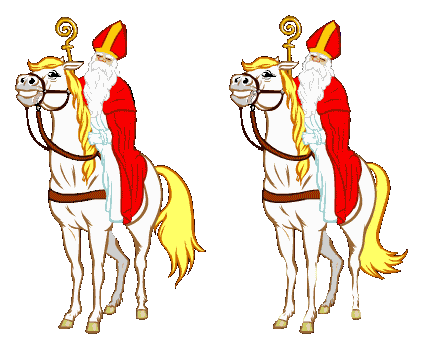 In the European countries, St. Nicholas is usually pictured as
a bearded saint, wearing ecclesiastical robes and riding a white
horse. He carries a basket of gifts for the good children and a
batch of rods for the naughty ones.
In the European countries, St. Nicholas is usually pictured as
a bearded saint, wearing ecclesiastical robes and riding a white
horse. He carries a basket of gifts for the good children and a
batch of rods for the naughty ones.
In old Czechoslovakia, Svaty Mikulas was brought down from heaven on a golden cord by an angel. When he arrived on Christmas Day, the children rushed to the table to say their prayers. If they did well, he told the angel who came with him to give them presents.
In parts of the Alps, "ghosts of the field" cleared the way for St. Nicholas. Behind them came a man wearing a goat's head, and a masked demon with a birch switch. In Germany, twelve young men dressed in straw and wearing animal masks danced along after St. Nicholas, ringing cowbells. At each house, after gifts were given, the masked men drove the young people out and pretended to beat them!
For the children of the Netherlands, December 6th is still more exciting than Christmas Day, for then St. Nicholas arrives. His arrival is celebrated and this is the day when children receive their presents. The excitement begins on the last Sunday in November, where everywhere can be heard the words, "Look there is the steamer bringing us St. Nick!"
St. Nicholas traditionally arrives by sea and disembarks at Amsterdam. He then mounts a white horse for a processional ride through the streets. Clothed in a bishop's scarlet cope and mitre, he wears white gloves and an enormous bishop's ring on his left hand. Black Peter accompanies Nicholas. St. Nicholas' arrival is greeted with cheers from the thousands of children and adults who line the route. Supposedly the bishop came from Spain. This story can be traced back to the sixteenth century when the Spanish dominated the Low Countries. The doublet, puffed velvet breeches, hose and plumed berets worn by his attendants – in particular Black Peter – are another forcible reminder of that period. Black Peter carries a large sack in which he is said to put all the boys and girls who have misbehaved during the course of the last 12 months. With bad kids in his sack, Black Peter then takes them away to Spain.
Immigrants to the New World must have recognized something familiar in the little figure of St. Nick. His fur costume suggested Pelz-Nicol to a Bavarian, and the little gnome-like figure Jule-nissen to a Scandinavian. His elfish qualities rang bells with other nationalities too, for example the Irish with their tradition of the "little people". In many ways, Santa was recognizable for many people, which probably helps to explain why he was adopted so readily – a new, but familiar, symbol for a new country.
 As in many other European countries, if presents were exchanged
at this season, it was usually done at New Year's Eve and they were
between adults rather than for children. In the 1840s, however,
there was an increasing emphasis on Christmas Day. This seems to
have happened for several reasons. The press – which now reached
a far wider audience – stressed the fact that Christmas Day
was the celebration of the birth of Jesus. Birthdays had always
been a day for giving presents and it was a natural step to celebrate
Jesus' birth by giving gifts on that day.
As in many other European countries, if presents were exchanged
at this season, it was usually done at New Year's Eve and they were
between adults rather than for children. In the 1840s, however,
there was an increasing emphasis on Christmas Day. This seems to
have happened for several reasons. The press – which now reached
a far wider audience – stressed the fact that Christmas Day
was the celebration of the birth of Jesus. Birthdays had always
been a day for giving presents and it was a natural step to celebrate
Jesus' birth by giving gifts on that day.
Before Christmas had been banned by Oliver Cromwell from 1644 to 1660, there had been an old custom of giving sweets and small presents to children on Christmas Day. This had virtually stopped, but now the custom was enjoying a revival, in part because of the many articles that were being written in the Christmas editions of magazines about the "old traditions" of Christmas. Another influential element was that, just as in America, children were becoming a greater focus in society, and it seemed appropriate to use this time to give them greater emphasis.
The importation of the Christmas tree from Germany, and the accompanying rituals of gift giving on Christmas Eve, gave further impetus to the idea of presents. Santa Claus provided the final influence. By the end of the century, Christmas Day was firmly fixed – in England at least – as a children's festival and the day on which presents were given.
Santa Claus, or "Father Christmas", came back into English Christmas festivities when people were reminded of him from America. This injected new life into the English Christmas and was the answer to those who prayed that Father Christmas and his customs may be restored "to some portion of their ancient honours".
Celebrations around the midwinter solstice had been used for gift giving since Roman times. At the Roman winter festival – called the Saturnalia because they worshipped Saturn as the god of everything that grew – the Romans had a public holiday that lasted for a week. Everyone took part in the feasting and games. Even the slaves were made free for a day and allowed to say and do what they liked. People exchanged presents; a custom called Strenae, as a symbol of goodwill. At first, these gifts were green boughs from the grove of the goddess Strenia. Later, gifts were given of sweet pastries to ensure a pleasant year, precious stones, gold or silver coins to symbolize wealth, and, the most popular of all, candles as a symbol of warmth and light. As the Roman Empire spread, so did this custom of gift giving to other parts of the world. Since the Saturnalia marked the beginning of a new year, in most countries presents were given on New Year's Day, not Christmas Day. The advent and spread of Christianity caused the gift giving to be moved to other times of the year.
In Germany, the packages of Christmas gifts were called "Christ-bundles" and often came in bundles of three. There was something rewarding, something useful and something for discipline. In the seventeenth century, a typical bundle would contain candy, sugarplums, cakes, apples, nuts, dolls and toys. The useful things would be clothes, caps, mittens, stockings, shoes and slippers. The gifts "that belong to teaching, obedience and discipline" were items such as ABC tables, paper, pencils, books and the "Christ-rod". This rod, attached to the bundle, was a pointed reminder for good behavior. Another way of presenting gifts was the old German custom of the "Christmas ship", in which bundles for children were stored away. To some extent, this custom was also adopted in England, but never with the same degree of popularity.
In the centuries before Santa Claus was well known, and still today in many countries where he has not been widely adopted, the child Jesus is the gift-bringer. He comes with the angels during the night, trimming the tree and putting the presents underneath.
In Spain and Spanish-speaking countries, the child Jesus (el Nino Jesus) brings Christmas gifts for the children during Holy Night. He is found in the morning in the previously empty crib, and all the presents are arranged in front of it.
The German name of the Christ Child is Christkind, commonly used in its diminutive form Christkindel. His messenger, a young girl with a golden crown who holds a tiny "Tree of Light", brings the gifts of the Christ Child. Still today in America, "Kriss Kringle" – deriving from the German Christkindel – is another name used for Santa Claus.
Santa may appear under different names and in different guises. For example, French children leave their shoes by the fireplace on Christmas Eve so that they can be filled with gifts by Pere Noel. In the morning they find that the shoes have been filled and that sweets, fruit, nuts and small toys have also been hung on the branches of the tree.
In Sweden, the children wait eagerly for Jultomten, whose sleigh is drawn by the Julbocker, the goats of the thunder god Thor. With his red suit and cap, and a bulging sack on his back, he looks much like Santa Claus as we know him. In Denmark, too, the gift-bringer Julemanden carries a sack and is brought by reindeer. Elves known as Juul Nisse come from the attic, where they live, to help with the chores during Yuletide. The children put a saucer of milk or rice pudding for them in the attic and are delighted to find it empty in the morning.
The children of Poland receive their gifts from the stars, while in Hungary the angels bring them. Children of Syria receive theirs from the Youngest Camel on January 6th, which is Three Kings' Day. The children of Spain, Mexico, Puerto Rico, the Philippines and South American countries also receive gifts at this time as well as on Holy Night, but from the Three Kings.
In Italy, an unusual figure is the gift bringer for children. It is the "Lady Befana" or "Bufana" (La Befana), the ageless wanderer. Apparently La Befana refused to go to Bethlehem with the wise men when they passed her door, and she has been searching for the Christ Child ever since. On the Eve of Three Kings' Day (Epiphany), she wanders from house to house, peering into the faces of the children and leaving gifts. On that day, the children roam the streets, blowing their paper trumpets and receiving the gifts which La Befana has given them. Her name comes from the word "Epiphany".
In Russia, Kolyada is the name for Christmas. The word is derived from the old Roman Kalends, the celebration of the New Year at the first of January. Kolyada is also the name of the white-robed woman who rides a sled drawn by a single white horse from house to house on Christmas Eve to bring gifts to the children. Kolya (Nicholas), who leaves wheat cakes on the windowsills, joins her. The gift bringer in Russia is also a legendary woman, called Babushka (Grandmother). She is said to have misdirected the Magi when they inquired their way to Bethlehem. According to another version, she refused hospitality to the Holy Family on its way to Egypt. Whatever her fault, she repented of her unkindness and, to make reparation for her sin, she now goes about the world on Christmas Eve looking for the Christ Child and distributing gifts to the children.
In Europe, after the Reformation of the seventeenth century, the feast and veneration of Saint Nicholas was abolished in many places, including England, where a figure known as Father Christmas was substituted. Father Christmas is a winter deity, white-haired and bearded, who wears a crown of holly. The German settlers brought their beliefs and stories about Saint Nicholas with them to this country during the two great waves of immigration, in the early 1700s and the middle 1800s, and Hollanders brought their Sinter Klaas to their settlement of New Amsterdam. As the English colonized New York, they adopted their Father Christmas, who did not bring gifts, to these traditions, and Santa Claus as we know him today was born.
Washington Irving first described Santa's sleigh flying. The sleigh was said to be pulled by reindeer – giving St. Nick an exotic link with the far north – a land of cold and snow where few, if any, people traveled and was hence mysterious and remote. The reindeer, however, were not first told by Irving. In a publication called The Children's Friend, a writer had described in 1821 "Old Sante Claus with much delight, His reindeer drives this frosty night". Washington Irving, in A History of New York, published in 1809, helped create the Americanized version of this mythic figure when he described the saint as "laying a finger beside his nose" and dropping gifts down chimneys.
Clement Moore's "An Account of a Visit from St. Nicholas" (popularly known as "The Night Before Christmas"} was published on December 23, 1823. Clement C. Moore told of eight reindeer and gave their names. Some scholars think that this poem was actually written by Henry Livingston, Jr., and there is compelling evidence to support this point of view. Perhaps Livingston had written a poem that Moore adapted. Whatever the case, in the now-famous poem, Santa is described as a "jolly old elf," with a team of eight reindeer, who comes to children on Christmas Eve Day, rather than December 6 or New Year's Day. One story recounts that Dr. Clement Moore was inspired to draw the present day Santa Claus by a short, chubby Dutch friend of his, who had sat by the fire telling stories of St. Nicholas.
Thomas Nast is another contributor to the American development of Santa Claus. Although he was born in Bavaria in the 1840s, he came to the United States when he was six years old. He grew up to become an editorial cartoonist and illustrator with flair; he is credited with creating and popularizing the Republican elephant and the Democratic donkey, the symbols of the two major political parties. He is also considered the primary source for the way we picture Santa Claus because of a series of drawings he did for Harper's Weekly between 1863 and 1886. Not having the vaguest idea what Santa Claus was supposed to look like, the Bavarian-born Nast drew Santa Claus as the winter holiday figure he remembered from the mountain villages in his Bavarian Alps; a rather scary, less-than-friendly gnome, dressed in animal skins and carrying a short broom-like rod with which to threaten girls and boys.
Over the years, Nast's Santa became a bit friendlier, until, in 1931, the Coca-Cola Company decided that they wanted to increase their sales to children. The law at the time did not allow advertisements showing children drinking Coca-Cola, so how about showing a friendlier Santa Claus, relaxing with a Coke served to him by children? The artist Haddon Sundblom was assigned to come up with a new, more commercial Santa. Instead of Moore's elf or Nast's grumpy gnome, Sundblom came up with a large, jolly fellow in the well-known, bright red suit with white fur trim (the Coca-Cola colors).
Together, Irving, Moore, Nast and Sundblom are largely responsible for the way we in America envision Santa Claus.

Copyright 2001, Michael McCann with The Business
Cafe. All Rights Reserved.
http://www.globalbusinesscafe.com/
All comments should be directed to Michael McCann at mccann@nc.rr.com